Meraki Espresso Machine Review: From Gen 1 Launch to Gen 2 Evolution
This Meraki espresso machine review started with skepticism. A customer kept asking about it. “Dual boilers, dual scales, rotary pump, under $2,000,” he said. “Sounds fake.” We ordered one to test. It is not fake. It is also not perfect. Here is what we found after pulling shots for three months.
Meraki is a Chinese company based in Shenzhen. They have been developing espresso machines for over 2 years. The name comes from Greek, meaning to do something with passion. We wanted to see if the product matched the motto.
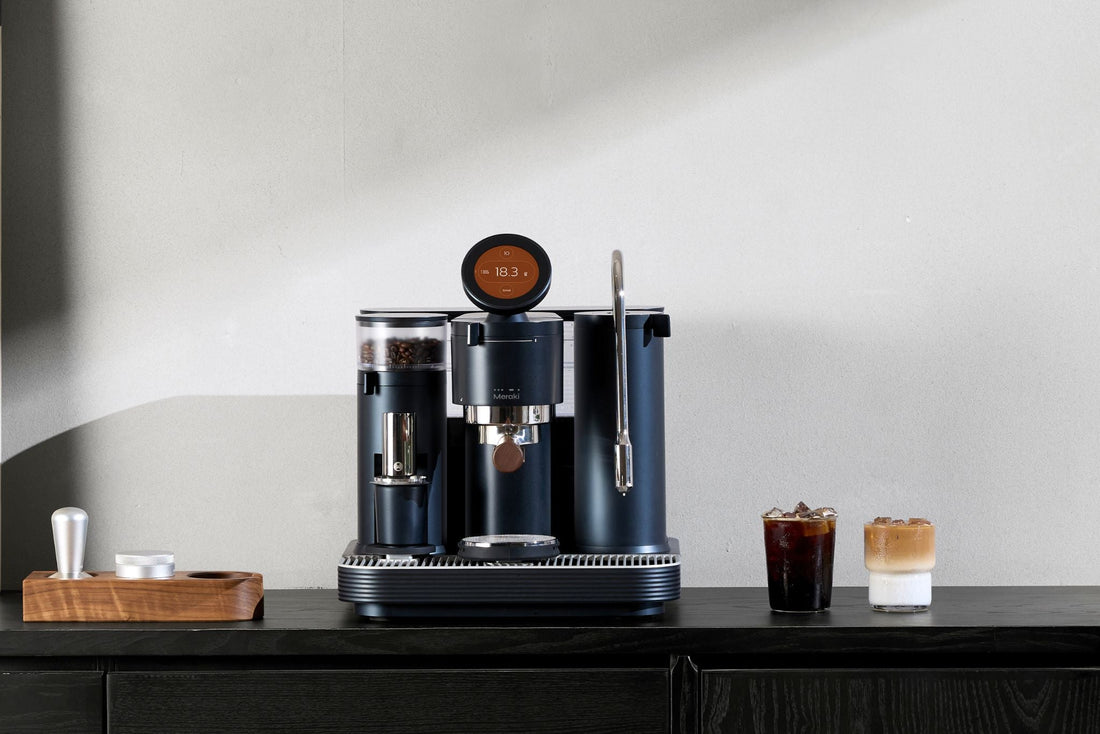
The machine is a dual boiler all-in-one unit with three cylindrical towers. Left is the grinder, middle is the brew boiler and group, right is the steam boiler. A circular touchscreen sits on top. Paddle switches on the brew and steam towers let you operate without the screen.
When we first saw the Kickstarter campaign, we ignored it. Space-age looks. Specs too good to be true. We assumed even if it funded, it would be all style and no substance. It funded to roughly $2 million. They brought it to production. We got one of the first production models.
Meraki Gen 1: Released in 2024
Price: $1749 (Out of stock)
The Gen 1 arrived with genuine innovations. True gravimetric dosing meant a scale under the grinder measured grounds in real time, stopping the motor at your target weight. A second scale under the group head measured shot yield, stopping extraction automatically. This was not volumetric guessing. This was actual weight-based control.
The grinder was a collaboration with Timemore, using 37mm conical steel burrs with stepless adjustment. A de-ionizer kept grounds static-free. The grinder sat in its own column, thermally isolated from the brew boiler. Smart design compared to competitors that baked beans with group head heat.
The steam wand was massive and gooseneck-shaped, with three holes and a temperature probe in the tip. Automatic steaming stopped at your set temperature. In our early tests, steaming 175ml of milk to 60 degrees Celsius added only 14 grams of water. Most machines we tested added 20 to 40 grams.
But it had problems. Early reviewers received prototype units with firmware bugs, temperature stability issues, and stiff portafilter fit. The proprietary portafilter meant you could not use standard 58mm accessories. The group head heater maxed at 120 degrees Fahrenheit, which some users found too cool. Build quality had rattles and loose components.
Meraki treated reviewers like beta testers. Transparent, yes. Risky, absolutely. Early videos showed these issues clearly, and potential buyers noticed.
We held off stocking the Gen 1. Too many unknowns. Too many “we will fix it in firmware” promises. The concept was brilliant. The execution needed time.
Meraki Gen 2: Early 2026
Price: $1999 (In Stock) Order Now
Meraki released the Gen 2 in early 2026. We ordered one immediately. The question was whether they had fixed Gen 1’s flaws or just repackaged them.
The answer: mostly fixed. The Gen 2 addressed nearly every hardware complaint we had tracked.
Universal 58mm portafilter compatibility was the biggest change. No more proprietary lock-in. You could now use any standard portafilter, basket, or bottomless accessory. This alone transformed the machine from isolated ecosystem to genuine open platform.
Wider grinding range meant the Timemore grinder could now go coarser for pour-over and drip, not just espresso-fine. The Gen 1 was strictly espresso-focused. The Gen 2 expanded versatility.
Redesigned shower screen improved water distribution across the puck. More even extraction, less channeling, better flavor clarity.
Improved group head heater range extended from 120 degrees to 160 degrees Fahrenheit. Users who wanted hotter group temps for light roasts now had headroom.
Better build quality tightened loose components and eliminated rattles. The portafilter handle became more robust. Firmware interface improved.
Grind-by-weight accuracy improved significantly. Our tests with an Acaia Lunar scale showed consistency within 0.1 to 0.2 grams. The Gen 1 had drifted more.
Heat-up times remained blazing: 3 minutes 35 seconds to brew-ready, 3 minutes 55 seconds to steam-ready. The rotary pump stayed quiet and stable. The steam wand remained excellent, still the best we have used on any home machine under $2,000.
The Gen 2 also inherited Gen 1’s strengths: Wi-Fi firmware updates, RFID CoffeeSense scanner, auto-on scheduling, and the dual gravimetric scales. The touchscreen interface received polish but kept the same functional design.
We started stocking the Gen 2 in May 2026. Returns so far are minimal. The only lingering complaint: occasional sleep mode quirk where the machine shuts down completely instead of sleeping. Meraki says firmware fix incoming.
What’s in the Box
- 58 mm bottomless portafilter with removable dual-spout attachment
- 18 g filter basket
- Blind basket (backflush disc)
- 58 mm tamper
- 58 mm distributor/leveler
- Magnetic dosing cup
- 12 oz milk pitcher
- Barista towel
- Tamping station
- Cleaning brush
- Water hardness test strips
- User manual
What Makes the Meraki Stand Out
Grind-by-Weight and Stop-by-Weight
This is the feature that made us pay attention. Most integrated grinder machines like Breville Barista Pro use timers. Timers drift. Bean density changes. Humidity shifts. The same grind time produces different doses by afternoon.
The Meraki has a scale under the grinder. You set your target dose weight. The motor stops when it hits that weight. Then a second scale under the group head measures your shot yield. The machine stops extraction at your programmed weight. Not volumetric guessing. Actual weight-based control.
This matters because water absorption varies by grind, dose, and coffee. Volumetric machines pump a set water volume. They do not account for what the puck soaks up. Weight-based control nails your brew ratio every time. Set dose to 18 grams, yield to 36 grams, and you get a 1:2 ratio without thinking.
We have sold high-end standalone grinders with this feature. Seeing it in an integrated machine under $2,000 was a genuine surprise.
Dual Boiler with Rotary Pump
Dual boilers let you brew and steam simultaneously. The Meraki has a 300ml stainless steel brew boiler and a 550ml stainless steel steam boiler. Both are PID controlled.
The rotary pump is quieter and more stable than vibration pumps. Normally this means plumb-in capability. Meraki chose not to offer a plumbing kit. They say it encourages tap water use without filtration. We think it is a missed opportunity. Customers should have the choice.
Pro-Level Steam Wand
The steam wand is massive and gooseneck-shaped. Three holes provide dry, powerful steam. A temperature probe in the tip reads milk surface temperature. Automatic steaming stops at your set temperature.
In our tests, steaming 175ml of milk to 60 degrees Celsius added only 14 grams of water. Most machines we have tested add 20 to 40 grams. The steam is that dry.
You can also steam manually with the paddle switch. This is the easiest manual steam wand we have used on any integrated grinder machine. Beginners can start with auto mode and graduate to manual control.
Fast Heat-Up
3 minutes 35 seconds to brew-ready. 3 minutes 55 seconds to steam-ready. That is blazing fast for dual boilers. Most competitors take 10 to 15 minutes.
Timemore Grinder with Thermal Isolation
The grinder uses 37mm conical steel burrs with stepless adjustment across 30 marked steps. A de-ionizer keeps grounds static-free. Grind speed is roughly 1.5 grams per second. An 18-gram dose takes 10 to 12 seconds.
The grinder sits in its own column, separate from the brew boiler and group head. This prevents bean heating. We have tested integrated machines like the Breville Barista Express that bake beans with group head heat. The Meraki avoids this entirely.
The planetary gearbox uses POM gears, not nylon. This gives the torque needed for dense, light roast beans without stripping.
Touchscreen and Wi-Fi Updates
The circular touchscreen is functional, not flashy. Three main icons: Grind, Steam, Brew. Swipe down for settings. The screen tilts slightly for shorter users.
Wi-Fi provides automatic firmware updates. Our unit runs Espresso OS 1.1.1-57 and MCU V4.0.6. Updates happen overnight. This means early adopters get improvements without buying new hardware.
CoffeeSense RFID Scanner
An RFID scanner sits on top. Partner roasters can create smart tags for their bags. Scan the tag and the machine loads recommended brew temp, dose, yield, and suggested grind size.
Clever feature. Limited roaster support currently. We think it will matter more as partnerships grow. The suggested grind size may vary slightly between units due to calibration differences, but it should get you close.
Gen 1 vs Gen 2 (What Stayed vs What Changed )
The Gen 2 production model we tested fixed nearly everything:
| Feature | Gen 1 (2024) | Gen 2 (2026) |
|---|---|---|
| Portafilter | Proprietary | Universal 58mm E61 compatible |
| Grinder range | Espresso-focused | Wider, handles pour-over |
| Shower screen | Standard | Redesigned for better distribution |
| Group head heater | Max 120°F | Max 160°F |
| Build quality | Prototype loose components | Tightened, rattle-free |
| Grind accuracy | Good, some drift | Excellent, 0.1-0.2g consistent |
| Price | $2,000 | $1,799 |
| Dual boilers | Yes | Yes |
| Rotary pump | Yes | Yes |
| Gravimetric dosing | Yes | Yes |
| Steam wand | Excellent | Excellent |
| Wi-Fi updates | Yes | Yes |
| RFID scanner | Yes | Yes |
The only lingering issue: occasional sleep mode quirk where the machine shuts down completely instead of sleeping. Meraki says firmware fix incoming.
Real Extraction Performance
We tested light, high-grown, single-origin beans that hit 10.5% TDS and 22% extraction yield. For an integrated grinder machine, that is seriously impressive. Most struggle with light roasts. The Meraki handled them without strain.
We did find one natural processed bean from Timor-Leste that ran too fast at grind size 1. We fixed it by increasing brew temp and extending the ratio. Most light roasts worked fine at standard settings.
Medium and dark roasts were straightforward. The grinder has enough range and the PID enough control to dial in most beans you will encounter.
Retention and Mess
Exchange retention runs about 1 gram max in our tests. The ionizer helps reduce static. We still purge a gram or two when coming back to the machine after idle time, unless we have not changed the grind setting.
The white color option shows every splash. We learned this the hard way during our first week of testing. Coffee stains on white ABS plastic do not wipe clean as easily as on metal. If you are particular about aesthetics, get the black version. Meraki offers both, though availability varies by region.
The magnetic dosing cup is a nice touch. It slides into place with a satisfying click. The 58mm portafilter fits standard accessories, which was not true of the Gen 1 proprietary design. We tested several aftermarket baskets and bottomless portafilters. All locked in cleanly.
Bottomless portafilter use can splash if your grind and tamp are not dialed in. This is standard for any machine. The attachable spout reduces mess for beginners still learning distribution. We recommend starting with the spout, then graduating to bottomless once your technique tightens.
The drip tray holds 0.6 liters. For home use, this lasts several days. Empty it before it fills completely. The tray slides out smoothly for cleaning. The grate on top lifts off for rinsing.
Noise and Daily Living
The rotary pump runs quieter than vibration pumps. You can hold a conversation while it operates. Not silent, but not disruptive. The grinder is louder than the pump. Conical burrs at 1.5 grams per second make a distinct whir. Not offensive, but you will know when someone is grinding.
Silent Technology insulates the steam boiler and brew group. The machine does not rattle or vibrate excessively. Our unit sits on a wooden counter without sliding. The 32 pound weight helps.
One quirk: the grinder motor has a slight hum after shutting off. It lasts about two seconds. We thought it was a defect. Meraki says it is normal, related to the planetary gearbox winding down. It does not affect performance.
Comparison with Real Competitors
vs Breville Oracle Jet ($2,000)
The Oracle Jet is Breville’s integrated grinder flagship. Single boiler with thermoblock. Volumetric dosing, not gravimetric. Barista assistance features guide beginners. Less hands-on control.
The Meraki has true dual boilers, weight-based dosing, and rotary pump. Better espresso workflow. Less hand-holding. The Oracle Jet is simpler. The Meraki is more precise.
Choose the Oracle Jet if you want guided simplicity. Choose the Meraki if you want gravimetric accuracy and pro-level steaming.
vs Lelit Bianca V3 + Eureka Mignon Libra ($2,500)
This combo is the traditional upgrade path. Separate grinder and machine. Flow control on the Lelit Bianca. Larger 55mm grinder burrs. Established reliability. Proven parts network.
The Meraki is all-in-one, more compact, and costs $500 less. But the Bianca/Libra combo offers more upgrade path, flow profiling, and long-term support.
Choose the combo if you want a showpiece with room to grow. Choose the Meraki if you want convenience and gravimetric accuracy in one box.
Who Should Buy
-
You want gravimetric dosing without separate scale
-
You make milk drinks daily and want pro-level steam
-
Fast heat-up matters for your routine
-
You value firmware updates and improving features
-
Counter space is limited but you want dual boiler performance
-
You need flow control or pressure profiling
-
You want to plumb in directly
-
Long-term parts availability worries you
-
You prefer established brands with decade-long track records
-
Budget is under $1,000
Pros and Cons
-
True gravimetric dosing for both grind and brew
-
Dual boilers with rotary pump under $2,000
-
Fastest heat-up we have tested in dual boiler class
-
Excellent steam wand with dry performance
-
Wi-Fi firmware updates keep improving features
-
Grinder thermally isolated from brew boiler
-
No flow control or pressure profiling
-
No plumb-in option despite rotary pump
-
Proprietary parts, long-term support unproven
-
Occasional sleep mode quirk
-
White color shows every splash
-
Bulky three-tower design not for all kitchens
The Meraki Gen 2 is the machine the Gen 1 should have been. It delivers on the original promise: dual boiler, gravimetric dosing, rotary pump, integrated grinder, under $2,000. The execution is now solid enough that we stock it and recommend it.
Is it perfect? No. No flow control. No plumbing. A new company with unproven longevity. Occasional firmware quirks.
But for home baristas who want push-button precision and pro-level milk steaming without buying separate grinder, scale, and machine, the Meraki is genuinely compelling. We use it in our showroom. We sell it to customers. We tell them the caveats upfront.
The evolution from Gen 1 to Gen 2 shows Meraki listens. They fixed what mattered. They kept what worked. That is more than we can say for many brands that have been around decades longer.
If you want cutting-edge convenience and are willing to bet on a young company, the Meraki is worth your consideration. If you want proven reliability and decades of parts availability, look at ECM Synchronika II or Profitec Pro 300.
We are an authorized dealer. We stand behind what we sell. We also tell the truth about what we do not know yet.
